
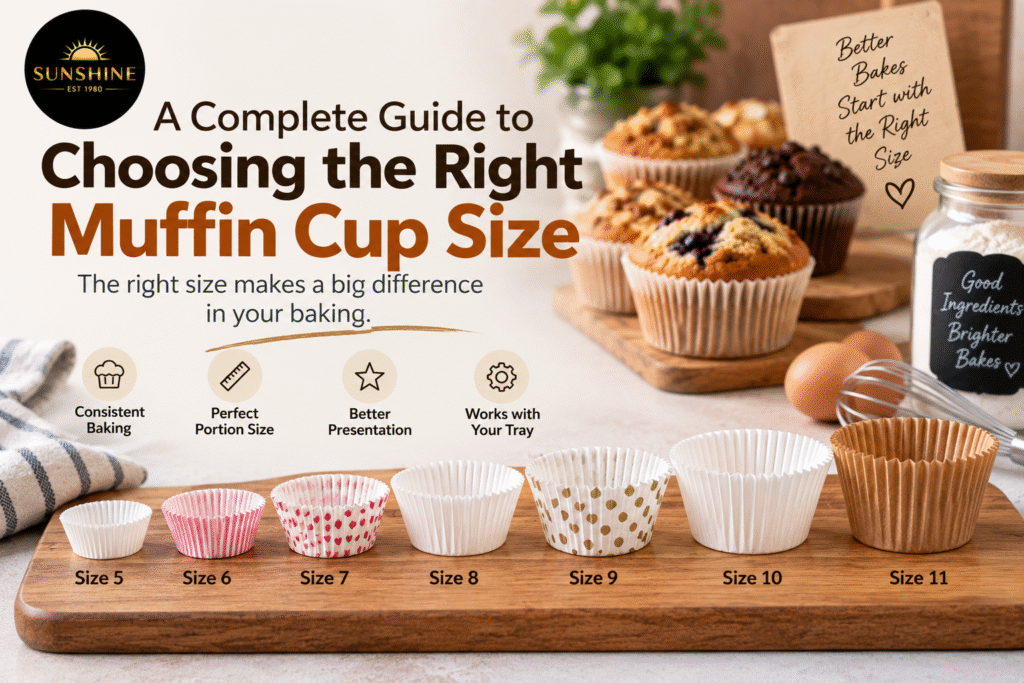
A Complete Guide to Choosing the Right Muffin Cup Size
Choosing the right muffin cup size may seem like a small decision, but for a bakery, café, or commercial baking business, it can have a noticeable impact on the final product.
The size of the muffin cup affects how much batter you can use, how the baked product looks, how it fits in your baking tray, and how consistently your products come out from one batch to another.
Whether you make muffins, cupcakes, small cakes, or other individual baked products, selecting the right cup size can make your baking process more organised and your presentation more consistent.
Sunshine Industrial Corporation offers muffin cups in sizes ranging from 5 to 11, giving bakeries several options for different baking requirements.
Why Muffin Cup Size Matters
Imagine preparing a large batch of cupcakes and discovering that the cups are too small for the amount of batter you normally use.
The batter may rise beyond the edges, making the products difficult to handle and affecting their appearance.
On the other hand, if the cups are too large, the same amount of batter may look undersized inside the liner.
For a bakery producing products every day, these small inconsistencies can become noticeable.
The right muffin cup size helps you work toward:
- Consistent portion sizes
- Better product presentation
- Easier handling
- More organised baking
- Consistent results across batches
- Better use of baking trays
Understanding Muffin Cup Sizes
Muffin cup sizes can vary depending on the manufacturer and product specifications. This is why you should not select a cup based only on a number printed on a catalogue.
Sunshine Industrial Corporation offers sizes 5 through 11.
Rather than assuming that a particular size will automatically suit your recipe, consider how the cup performs with your actual batter, baking tray, and finished product.
If you are introducing a new product, testing different sizes before placing a large order can help you identify the most suitable option.
1. Start With Your Product
The first question to ask is simple:
What are you baking?
A standard muffin may require a different cup from a small cupcake or another individual baked product.
Think about the final size and appearance you want.
For example, if your bakery sells a consistent range of cupcakes, the cup should complement the portion size you have established for that product.
Your goal should be to make the cup and the product look like they belong together.
2. Consider How Much Batter You Use
The amount of batter placed in each cup is another important factor.
If you normally use a particular quantity of batter for each muffin, test how that quantity behaves in different cup sizes.
Look at:
- How much the batter rises
- Whether the product stays within the cup
- The final shape
- How much of the cup remains visible
- Whether the finished product looks consistent
Testing is particularly useful because different recipes can behave differently during baking.
A chocolate muffin, for example, may not rise in exactly the same way as another recipe.
3. Check Your Baking Tray
Your muffin cup needs to work with your baking equipment.
Before ordering in bulk, check that the selected cup fits properly into the cavities of your muffin tray.
The cup should sit comfortably without being excessively compressed or loosely positioned.
For commercial bakeries, it is worth testing the cup with the exact trays and equipment used during normal production.
This can prevent unnecessary problems after a large order has already been placed.
4. Think About the Final Presentation
Size isn’t only about baking performance. It is also about appearance.
Customers expect products from a professional bakery to look consistent.
If you sell ten cupcakes together, customers should ideally see ten products with a similar portion and presentation.
A suitable muffin cup can help create a more uniform appearance across the display counter, takeaway box, or catering order.
This becomes especially important when your bakery sells premium or customised products.
5. Consider Your Portion Sizes
Muffin cups can also help a bakery maintain consistent portions.
Once you establish a particular cup size and determine the appropriate amount of batter for it, your baking team can follow the same process for future batches.
This can make production easier to standardise.
For commercial bakeries, consistent portioning can also help with inventory planning because you have a clearer idea of how much batter and how many muffin cups are needed for a particular number of products.
6. Don’t Choose a Size Based Only on Price
When buying muffin cups in bulk, it can be tempting to focus entirely on the price.
But the cheapest cup isn’t necessarily the most suitable one for your bakery.
Consider the complete value:
- Is the size appropriate?
- Does it work with your baking tray?
- Does it suit your recipe?
- Does it provide the appearance you want?
- Is the paper suitable for your intended food application?
- Can the supplier provide consistent quality?
- Can they supply the quantity you require?
A cup that doesn’t work properly can lead to unnecessary waste and production problems.
7. Plain or Printed Cups: Does Size Matter?
Both plain and printed muffin cups can be available in different sizes.
The choice between them usually depends on presentation rather than the basic sizing principle.
Plain muffin cups can be suitable for:
- Everyday muffins
- Regular bakery production
- Commercial orders
- Catering
- Simple product presentation
Printed muffin cups can be useful for:
- Special occasions
- Birthday orders
- Celebrations
- Premium cupcakes
- Gift boxes
- Visually focused bakery products
Whichever style you choose, make sure the size suits the actual product.
8. Think About Your Customers
Your customers can also influence the size you choose.
A bakery specialising in individual cupcakes may have different requirements from a business supplying large quantities of baked products to cafés or commercial buyers.
Ask yourself:
- What portion size do customers expect?
- How are the products sold?
- Are they sold individually or in boxes?
- Are they mainly everyday products or special orders?
- Does presentation play a major role in the purchase?
Your answers can help you decide which muffin cup size fits your business model.
9. Test Before Placing a Bulk Order
This is one of the most useful steps for any bakery.
If you’re unsure about a particular size, don’t immediately place a large order.
Instead, test the cup with your normal:
- Recipe
- Batter quantity
- Baking tray
- Oven settings
- Production process
Check the product after baking.
Does it look right? Does the cup hold the product comfortably? Is the portion size what you expected?
Once you’re satisfied with the results, you can move toward regular or bulk purchasing with greater confidence.
10. Plan Your Stock Based on Production
Once you know which sizes work for your products, consider how many cups you actually use.
Sunshine Industrial Corporation’s product information specifies 500 pieces per roll and a minimum order quantity of 500 rolls for its muffin cup range.
For a business ordering at this scale, production planning becomes important.
Keep track of your regular consumption and consider your busiest periods. Running out of muffin cups during a busy weekend or festive season can disrupt your baking schedule.
Food-Grade Quality Still Matters
Choosing the right size is important, but size shouldn’t be considered in isolation.
Muffin cups come into contact with food, so the material and quality of the paper are also important considerations.
Sunshine Industrial Corporation uses 32 GSM Food Grade PUDUMJEE Packing Tissue Papers for its muffin cups.
When selecting a supplier, ask about the paper specification, intended food application, available sizes, and consistency of supply.
Choosing Muffin Cup Sizes With Sunshine Industrial Corporation
Sunshine Industrial Corporation has been manufacturing muffin cups since 1980 from its facility in Bykampady Industrial Estate, Mangalore.
The company provides plain and printed muffin cups in sizes ranging from 5 to 11, allowing bakeries to select products according to their baking and presentation requirements.
Whether you’re producing everyday muffins, cupcakes for special occasions, or other suitable bakery products, testing the right size before committing to a bulk order can help you find a solution that works for your production process.
A Simple Checklist Before Ordering
Before placing your next muffin cup order, go through this checklist:
✓ Know your product size
Understand the final portion you want to produce.
✓ Check your batter quantity
Test how much batter works well with the cup.
✓ Measure your baking tray
Make sure the cup fits your equipment.
✓ Test the finished product
Look at shape, presentation, and consistency.
✓ Check the paper quality
Choose a product appropriate for your intended food application.
✓ Decide between plain and printed
Match the style to your product and customers.
✓ Calculate your monthly usage
Plan your stock around actual production.
✓ Test before bulk ordering
Especially when changing suppliers or cup sizes.
Final Thoughts
There isn’t one muffin cup size that works for every bakery.
The right choice depends on your product, batter quantity, baking tray, portion size, presentation, production volume, and customer expectations.
Sunshine Industrial Corporation’s range of sizes from 5 to 11 gives bakeries flexibility, but the best way to select a size is to test it with your own recipe and equipment.
Once you find the size that gives you the right combination of baking performance, presentation, and consistency, maintaining that standard across your production can make everyday baking much easier.
The right muffin cup isn’t simply the one that fits the tray—it is the one that fits your product, your process, and your bakery.