
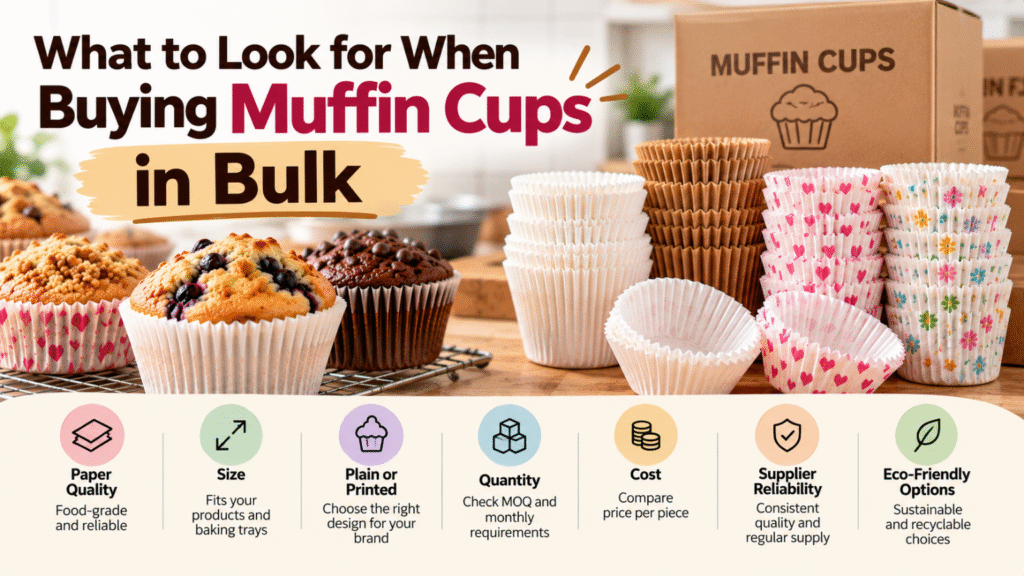
What to Look for When Buying Muffin Cups in Bulk
For a bakery, café, catering business, or commercial baking unit, muffin cups are not a one-time purchase. They are a regular part of production, which means buying them in bulk can be practical and cost-effective.
However, ordering large quantities without checking the product properly can create unnecessary problems. The wrong size, unsuitable paper, inconsistent quality, or unreliable supply can affect your baking process and product presentation.
So, what should you actually look for when buying muffin cups in bulk?
The answer goes beyond price. You need to consider the paper quality, size, quantity, intended application, presentation, supplier reliability, and how well the product fits your bakery’s everyday requirements.
Why Buying Muffin Cups in Bulk Requires Planning
If you use only a few muffin cups occasionally, choosing a supplier may seem simple. But when your bakery uses hundreds or thousands of cups regularly, even a small difference in quality can become noticeable.
For example, imagine a bakery producing 2,000 cupcakes every week. If the cups don’t fit properly, don’t perform as expected, or aren’t consistently available, the problem affects the entire production process.
Bulk purchasing should therefore be treated as part of your bakery’s supply planning.
Before placing an order, understand exactly what your business needs.
1. Check the Muffin Cup Size
Size should be one of the first things you check.
Not every muffin or cupcake requires the same size cup. Your choice should depend on the size of the finished product, amount of batter, and baking tray you use.
Sunshine Industrial Corporation offers muffin cups in sizes ranging from 5 to 11, providing options for different baking requirements.
Before ordering in bulk, consider:
- The dimensions of your baking tray
- Your usual batter quantity
- The finished product size
- The desired portion size
- How the cup looks after baking
- Whether the cup fits properly in your equipment
If you’re changing sizes or trying a new supplier, test the product first. A small test can prevent a much bigger problem after a bulk order arrives.
2. Look at the Paper Quality
The material used for the muffin cup is another important consideration.
Muffin cups come into direct contact with food, so bakeries should pay attention to the paper specification and whether the product is suitable for its intended food application.
Sunshine Industrial Corporation uses 32 GSM Food Grade PUDUMJEE Packing Tissue Papers for its muffin cups.
When comparing suppliers, don’t simply ask, “How much does it cost?”
Also ask:
- What type of paper is used?
- What is the GSM?
- Is the paper food grade?
- What applications is the cup designed for?
- Is the quality consistent between batches?
Knowing these details can help you make a more informed purchasing decision.
3. Decide Between Plain and Printed Muffin Cups
Bulk purchasing doesn’t necessarily mean buying only one style.
Depending on your business, you may need either plain muffin cups, printed muffin cups, or both.
Plain Muffin Cups
Plain cups are suitable for businesses looking for a simple and clean appearance.
They can work well for:
- Everyday muffins
- Regular cupcakes
- Commercial bakery production
- Catering
- Large-volume orders
- Standard bakery products
Printed Muffin Cups
Printed cups can add colour and visual appeal to your products.
They can be useful for:
- Birthday orders
- Weddings
- Parties
- Special occasions
- Premium cupcakes
- Gift boxes
- Attractive bakery displays
If your bakery serves different types of customers, keeping both options can give you greater flexibility.
4. Consider Your Monthly Consumption
One of the biggest mistakes businesses make when buying in bulk is ordering without understanding their actual consumption.
Start by calculating how many muffin cups you use in a typical week.
For example:
Daily production: 500 muffins
Working days: 6 per week
Weekly requirement: 3,000 cups
Once you understand your average usage, you can estimate your monthly requirement and plan your purchases accordingly.
Also consider seasonal demand. A bakery may use significantly more muffin cups during:
- Festival seasons
- Wedding seasons
- School events
- Corporate events
- Holiday periods
- Special promotions
Having enough stock is important, but excessive inventory can also take up storage space.
5. Check the Supplier’s Minimum Order Quantity
Every supplier may have different bulk-order requirements.
Sunshine Industrial Corporation’s product information specifies a minimum order quantity of 500 rolls for its muffin cups, with 500 pieces per roll based on the stated product specifications.
Before placing an order, make sure the supplier’s minimum quantity makes sense for your business.
If your bakery needs large quantities regularly, a bulk MOQ may fit naturally into your purchasing process.
If your consumption is lower, you should consider your storage capacity and usage rate before ordering.
6. Calculate the Cost Per Piece
Don’t compare suppliers only by the price of a package or roll.
Instead, calculate the approximate cost per muffin cup.
The basic calculation is:
Cost per cup = Total purchase cost ÷ Total number of cups
This gives you a clearer basis for comparing different suppliers.
But price per piece shouldn’t be the only consideration.
A cheaper cup isn’t necessarily better if it results in:
- Inconsistent quality
- Product wastage
- Poor presentation
- Supply problems
- Incorrect sizing
- Frequent replacements
Think about the total value rather than just the initial price.
7. Ask About Food-Grade Suitability
Because muffin cups come into direct contact with baked products, food-grade suitability should be an important part of your purchasing decision.
Ask your supplier for clear information about the material and intended food application.
This is particularly important for commercial bakeries that purchase large quantities and need confidence in the products they use every day.
A professional supplier should be able to explain the material specifications rather than leaving you to guess.
8. Consider Eco-Friendly Options
Packaging choices are becoming increasingly important for businesses and customers.
If sustainability is part of your bakery’s packaging strategy, you may want to consider paper muffin cups that are positioned as eco-friendly and recyclable.
Sunshine Industrial Corporation focuses on eco-friendly and recyclable muffin cups.
However, don’t rely on the term “eco-friendly” alone. Ask about the actual material, recyclability, and disposal requirements of the product.
This allows you to make environmental claims about your packaging responsibly.
9. Check Whether the Supplier Offers Consistent Quality
When buying in bulk, consistency matters.
You don’t want the first order to be excellent and the next order to be noticeably different.
Ask yourself:
- Does the supplier have experience in muffin cup manufacturing?
- Can they supply the same size consistently?
- Are plain and printed options available?
- Can they handle repeat orders?
- Do they understand commercial bakery requirements?
For a business that depends on regular production, supplier reliability can be just as important as the product itself.
10. Test the Cups Before a Large Commitment
This is one of the most practical steps you can take.
If you’re working with a new supplier or trying a new muffin cup size, test it with your actual production process.
Use your:
- Normal recipe
- Regular batter quantity
- Baking tray
- Oven
- Standard baking time
Then check the finished product.
Look at the shape, presentation, handling, and overall performance.
A cup that looks perfect in a catalogue may behave differently with your particular recipe and equipment.
Testing helps you make the decision based on real results.
11. Make Sure the Cups Fit Your Baking Trays
A bulk order is not useful if the cups don’t work properly with your existing equipment.
Check the dimensions carefully before ordering.
The cups should sit appropriately inside the cavities of your baking trays without being excessively compressed or loosely positioned.
This is particularly important for commercial bakeries where production needs to move quickly.
A small sizing issue can become frustrating when you’re working with multiple trays and large batches every day.
12. Think About Storage
Bulk buying means you’ll need somewhere to keep your stock.
Muffin cups should be stored in a clean, dry environment where they can remain protected from moisture, dust, and unnecessary handling.
Before ordering a large quantity, consider:
- Available storage space
- Packaging of the rolls
- Expected usage rate
- Protection from moisture
- Stock rotation
- Seasonal demand
Good inventory management can help you avoid both shortages and unnecessary overstocking.
13. Consider Your Product Presentation
The muffin cup becomes part of the final product presentation.
If you sell premium cupcakes, printed cups may help create a more attractive appearance.
If you sell everyday muffins, plain cups may provide a clean and professional look.
Think about where the product will be sold.
A café counter, bakery display, catering event, and takeaway box may all require slightly different presentation approaches.
14. Look at the Supplier’s Experience
Experience can be useful when selecting a long-term supplier.
Sunshine Industrial Corporation has been manufacturing muffin cups since 1980 from its facility at Bykampady Industrial Estate in Mangalore.
The company offers plain and printed muffin cups in multiple sizes and also supplies food-grade ammonium bicarbonate for relevant bakery applications.
For a bakery looking for regular supplies, working with an experienced manufacturer or supplier can make communication and repeat ordering easier.
15. Don’t Forget About Your Future Requirements
Your current requirements may not be the same six months from now.
Perhaps you’re planning to:
- Introduce new cupcake flavours
- Add premium products
- Expand catering
- Supply cafés
- Take larger event orders
- Increase production
- Open another location
When choosing a supplier, consider whether they can support your future requirements as well as your current ones.
A supplier offering multiple sizes and styles can give your bakery more flexibility as the business grows.
A Simple Bulk Buying Checklist
Before placing a large muffin cup order, go through this checklist:
Product
☐ Is the cup suitable for my products?
☐ Is the paper appropriate for food contact?
☐ Is the size correct?
☐ Does it fit my baking tray?
☐ Is the quality consistent?
Design
☐ Do I need plain cups?
☐ Do I need printed cups?
☐ Does the design suit my products?
Quantity
☐ How many cups do I use each month?
☐ What is the supplier’s MOQ?
☐ Do I have enough storage space?
☐ Will my stock last through busy periods?
Supplier
☐ Is the supplier experienced?
☐ Can they handle repeat orders?
☐ Can they supply the required sizes?
☐ Can they maintain consistent quality?
Cost
☐ What is the cost per cup?
☐ Are there additional delivery costs?
☐ Does the price make sense for my production volume?
Why Sunshine Industrial Corporation?
Sunshine Industrial Corporation has been manufacturing muffin cups since 1980, serving businesses in the baking and confectionery industry from Mangalore.
The company offers plain and printed muffin cups, with sizes ranging from 5 to 11, using 32 GSM Food Grade PUDUMJEE Packing Tissue Papers.
For businesses purchasing muffin cups in bulk, having different size and design options can make it easier to select products according to their production requirements.
The company also deals in Mangala Ambica Ammonium Bi Carbonate Food Grade, supplied in 25 KG bags for relevant bakery applications.
Final Thoughts
Buying muffin cups in bulk can make sense for a bakery, but the best bulk purchase isn’t necessarily the one with the lowest price.
The right choice should balance quality, size, food-grade suitability, presentation, quantity, storage, cost, and supplier reliability.
Start by understanding how many cups your bakery actually uses. Then test the size and product quality with your recipes and equipment. Once you’re confident about the product, you can plan your bulk orders around your regular production and seasonal demand.
For bakeries, muffin cups may be a small part of the overall business, but they are used repeatedly. Choosing the right supplier and product can therefore make everyday baking operations more consistent and easier to manage.
Buy in bulk when it makes sense—but make sure you’re buying the right muffin cups first.