
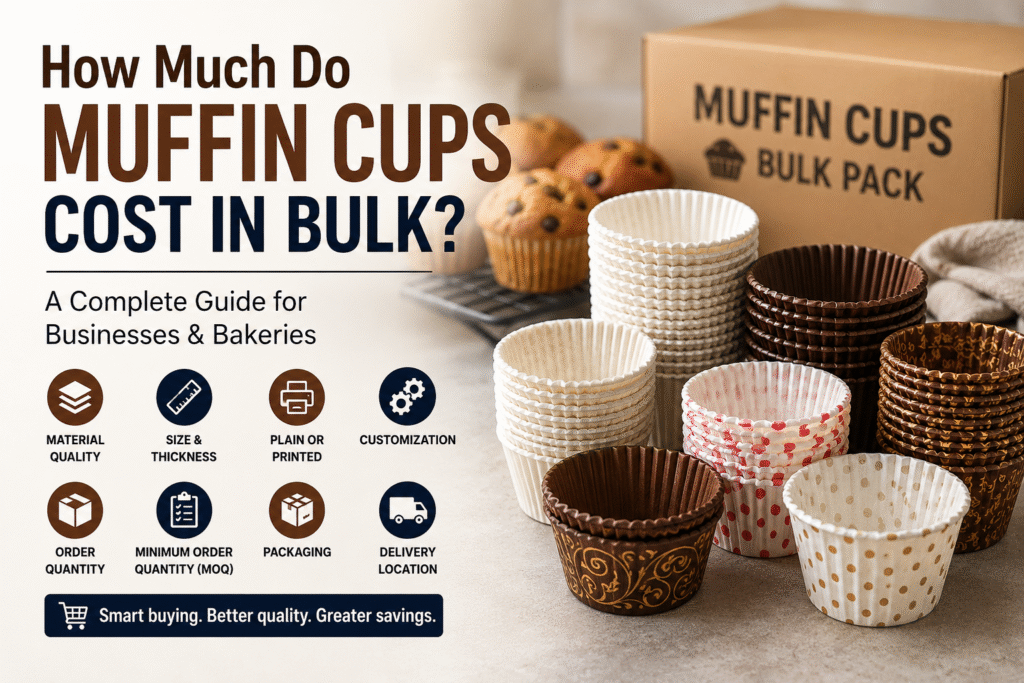
How Much Do Muffin Cups Cost in Bulk? A Buyer’s Guide
If you run a bakery, café, catering business, hotel, or food manufacturing unit, muffin cups are one of those supplies you need to purchase regularly. When your business uses hundreds or thousands of cups every month, even a small difference in the price per piece can have a noticeable impact on your overall expenses.
This naturally leads to an important question: how much do muffin cups cost in bulk?
There isn’t one fixed price that applies to every order. The final cost depends on several factors, including the material, size, design, quantity, printing, packaging, and delivery requirements.
This guide explains the main factors that influence bulk muffin cup pricing and what businesses should consider before placing a large order.
Why Bulk Muffin Cup Pricing Varies
Two muffin cups may look similar but have different manufacturing costs.
For example, pricing can change depending on:
- Material quality
- Cup size
- Paper thickness
- Plain or printed design
- Order quantity
- Customization
- Packaging
- Delivery location
- Manufacturing requirements
This is why it’s better to compare quotations based on the complete product specification, rather than simply looking at the price per piece.
Does Buying Muffin Cups in Bulk Save Money?
In many cases, buying larger quantities can reduce the average cost per cup.
Manufacturers can produce larger quantities more efficiently, and businesses may receive wholesale pricing for bulk orders.
Bulk purchasing can also reduce the number of individual orders you need to place throughout the year.
For a bakery that uses muffin cups every day, this can make both financial and inventory sense.
However, don’t automatically order the largest possible quantity. Your order should match your actual consumption and storage capacity.
1. Material Quality Affects the Price
The material used to manufacture the muffin cup is one of the first things that can influence pricing.
Food businesses should look for suitable food-grade materials designed for their intended baking application.
Factors such as:
- Paper quality
- Thickness
- Strength
- Heat resistance
- Grease resistance
- Overall finish
can influence manufacturing costs.
A cheaper cup isn’t necessarily the better choice if it performs poorly during baking or results in more product wastage.
2. Size Makes a Difference
Muffin cups are available in different sizes.
For example, a bakery may require:
- Mini muffin cups
- Standard muffin cups
- Larger baking cups
- Cupcake cups
- Custom sizes
Larger or specially manufactured cups may have different material requirements and production costs.
Before requesting a quotation, provide the manufacturer with the exact size you need.
3. Plain Muffin Cups Usually Have Simpler Pricing
Plain muffin cups are commonly used for everyday bakery production.
They can be suitable for:
- Muffins
- Cupcakes
- Brownies
- Mini cakes
- Other bakery products
Since they don’t require custom artwork or printing, their pricing structure can be simpler.
For businesses focused primarily on high-volume production, plain cups can be a practical option.
4. Printed Muffin Cups Cost More Than Plain Cups
If you want your logo or design printed on the muffin cups, additional production requirements may affect the cost.
Custom printed cups may involve:
- Artwork preparation
- Printing setup
- Ink or printing materials
- Additional production steps
- Minimum order quantities
The exact cost depends on the manufacturer’s process and the complexity of your requirements.
However, printed muffin cups can provide additional branding value for bakeries and food businesses.
5. Customization Can Influence the Total Cost
Businesses sometimes require more than standard sizes or designs.
Customization could involve:
- Brand logos
- Specific colors
- Decorative patterns
- Seasonal designs
- Custom sizes
- Special packaging
The more customized the order, the more important it becomes to discuss specifications with the manufacturer before requesting a final quotation.
6. Order Quantity Matters
One of the biggest factors in bulk pricing is quantity.
A business ordering 5,000 cups may receive a different price per piece from a business ordering 50,000 or 100,000 cups.
Before placing your order, ask the manufacturer for pricing at different quantity levels.
For example:
| Order Quantity | What to Compare |
|---|---|
| Small bulk order | Minimum order and unit price |
| Medium bulk order | Wholesale pricing |
| Large bulk order | Best per-unit pricing |
| Recurring order | Long-term pricing options |
This allows you to find the quantity that provides good value without creating unnecessary inventory.
7. Minimum Order Quantity Is Important
Manufacturers may have a minimum order quantity (MOQ), especially for printed or customized muffin cups.
Before finalizing your purchase, ask:
- What is the MOQ for plain cups?
- What is the MOQ for printed cups?
- Is the MOQ different for each size?
- Does the price change with quantity?
- Can different designs be combined?
Knowing the MOQ in advance prevents unexpected costs.
8. Packaging Can Affect the Final Cost
When ordering thousands of muffin cups, packaging becomes an important part of the supply process.
Good packaging helps protect the cups during transportation and storage.
Depending on the order, packaging may need to protect products from:
- Moisture
- Dust
- Crushing
- Deformation
- Handling damage
When comparing manufacturers, ask whether packaging is included in the quoted price or charged separately.
9. Don’t Forget Delivery Costs
A quotation may look attractive until transportation costs are added.
Always ask whether the quoted price includes delivery and, if not, what the expected transportation cost will be.
Your actual purchasing cost can be viewed as:
Product Cost + Customization + Packaging + Delivery + Applicable Charges
Comparing this complete figure gives you a more accurate picture of which manufacturer offers the best value.
10. Quality Can Affect Your Real Cost
Price per cup is only one part of the equation.
Imagine buying cheaper muffin cups but experiencing:
- Tearing
- Shape problems
- Inconsistent sizing
- Poor presentation
- Higher product waste
The money saved on the initial purchase could be lost through production problems.
That’s why businesses should consider cost per usable cup, rather than simply cost per purchased cup.
A consistent, reliable product may provide better value over time.
How to Calculate Your Bulk Muffin Cup Requirement
Before asking for a quotation, calculate your expected usage.
Start with your average monthly consumption.
For example:
Monthly usage × Number of months you want to stock = Estimated order quantity
Then consider additional demand during:
- Festivals
- Holidays
- Wedding seasons
- Promotional campaigns
- Business expansion
Don’t forget to consider your available storage space.
The goal is to purchase enough stock to maintain production without tying up unnecessary working capital.
Should You Buy a Few Months’ Supply?
For businesses with predictable consumption, keeping several months of inventory may be useful.
However, the right quantity depends on:
- Monthly usage
- Storage conditions
- Manufacturer lead time
- Cash flow
- Seasonal demand
- Available storage
If your manufacturer can provide reliable repeat deliveries, you may not need to maintain a very large inventory.
Questions to Ask Before Accepting a Quotation
When comparing bulk muffin cup manufacturers, ask:
- What is the price per piece?
- What quantity is the quotation based on?
- Is the price different for larger orders?
- What material is used?
- What sizes are available?
- Is custom printing available?
- What is the minimum order quantity?
- Are packaging costs included?
- Is delivery included?
- How long will production take?
- Can I receive samples?
- What happens if my monthly requirement increases?
Getting clear answers makes it much easier to compare quotations.
How to Get Better Value When Buying in Bulk
You don’t necessarily need to negotiate aggressively to reduce your purchasing cost. Better planning can also improve your overall value.
Know Your Requirements
Have your preferred size, material, design, and quantity ready before requesting quotations.
Compare Multiple Quantity Levels
Ask for pricing at different order quantities to understand where the best value lies.
Consider Repeat Orders
If you purchase regularly, ask whether the manufacturer can offer a consistent supply arrangement.
Avoid Unnecessary Customization
If branding isn’t important for a particular product, plain cups may be more economical.
Reduce Emergency Purchases
Planning orders in advance can help prevent last-minute purchases at potentially higher costs.
Sunshine Industrial Corporation for Bulk Muffin Cup Requirements
For bakeries and food businesses looking for bulk muffin cup manufacturing, Sunshine Industrial Corporation provides muffin cup solutions for commercial requirements.
Its range can include:
- Food-grade muffin cups
- Plain muffin cups
- Printed muffin cups
- Different sizes and designs
- Custom printing options
- Bulk orders
- Wholesale supply
If you’re considering a bulk purchase, discuss your required size, quantity, design, material specifications, and delivery location with the manufacturer to receive pricing based on your actual requirements.
Choosing the Cheapest Muffin Cup Isn’t Always the Best Decision
It’s natural to focus on price when comparing bulk suppliers. But your final decision should consider the complete value.
A good manufacturer should provide a balance of:
Competitive pricing + consistent quality + reliable supply + suitable materials + dependable service
This combination can help you avoid hidden costs associated with poor-quality products, production interruptions, and frequent emergency orders.
Final Thoughts
So, how much do muffin cups cost in bulk? The answer depends on the specific product and order requirements. Material, size, quantity, printing, customization, packaging, and delivery can all influence the final price.
Instead of looking for one universal price, identify exactly what your business needs and request a detailed quotation from a manufacturer.
For bakeries, cafés, catering companies, and food manufacturers, buying in bulk can be a practical way to manage recurring packaging costs. With proper planning and a reliable manufacturing partner, you can achieve a good balance between price, quality, and supply reliability.
Before placing your next bulk order, request samples, compare complete quotations, confirm specifications, and choose a manufacturer that can support your business not just for one order, but for the long term.