
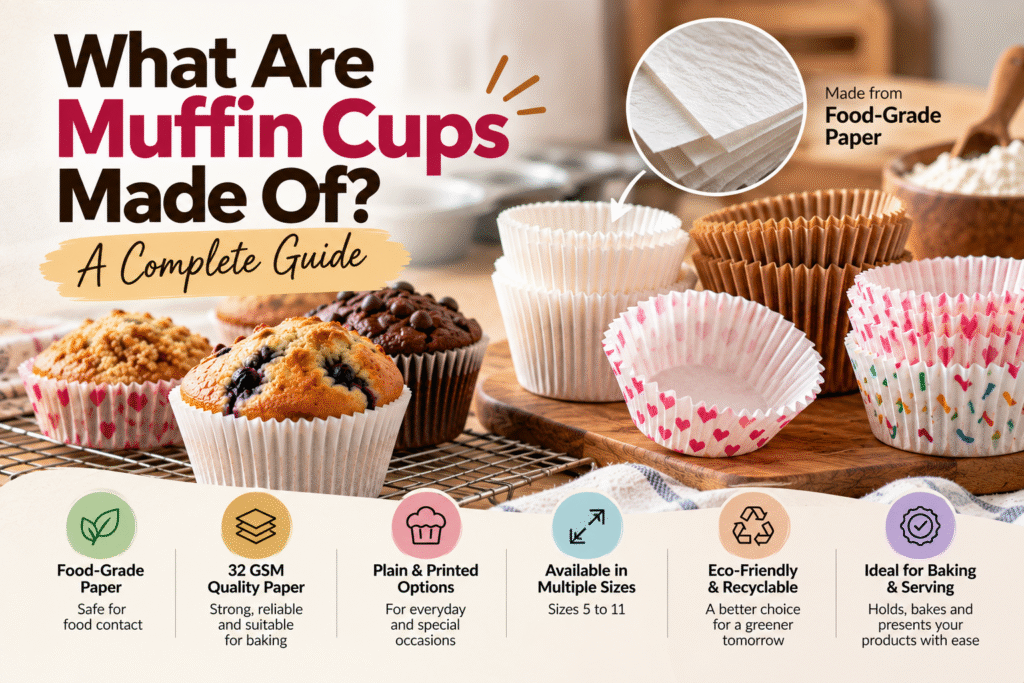
What Are Muffin Cups Made Of? A Complete Guide
When you look at a muffin or cupcake, the paper cup around it might seem like a small detail. But that simple-looking cup has an important job. It holds the batter during baking, makes the finished product easier to handle, and adds to the overall presentation.
For bakeries and food businesses, the material used to make muffin cups matters. The paper needs to be suitable for food applications while also offering the right combination of strength, convenience, and presentation.
So, what are muffin cups actually made of?
Let’s take a closer look.
What Are Muffin Cups?
Muffin cups, also commonly called cupcake liners, are paper cups used to hold individual baked products.
They are commonly used for:
- Muffins
- Cupcakes
- Small cakes
- Other small baked goods
- Certain Indian sweets
The cup is placed inside a suitable baking tray, filled with batter, and baked along with the product. Once baked, the paper cup remains around the product, making it easier to handle and serve.
Depending on the application, muffin cups can be plain or printed and are available in different sizes.
What Material Are Muffin Cups Made From?
Muffin cups are generally made from paper suitable for food-contact applications.
At Sunshine Industrial Corporation, the muffin cups are made using 32 GSM Food Grade PUDUMJEE Packing Tissue Papers.
The company manufactures plain and printed muffin cups in sizes ranging from 5 to 11.
The choice of paper is important because the cup comes into direct contact with the baked product.
Why Is Paper Quality Important?
Not all paper products are designed for the same purpose.
A muffin cup needs to perform its job while holding food during the baking and serving process. That’s why bakeries should pay attention to the material specification rather than choosing a product based only on appearance or price.
Good-quality food-grade paper can contribute to:
- Convenient handling
- Consistent product presentation
- Suitable food-contact use
- Better everyday bakery operations
- Easy serving
For commercial bakeries, consistency is particularly important because the same product may be used hundreds or thousands of times during regular production.
What Does “Food Grade” Mean?
The term food grade refers to materials intended for use in applications involving food.
Since muffin cups come into direct contact with muffins, cupcakes, and other baked products, bakeries should choose products made from paper suitable for their intended food application.
When purchasing muffin cups, it is reasonable to ask the supplier about:
- The type of paper used
- Paper specifications
- Food-contact suitability
- Product quality
- Intended applications
- Available sizes
This information can help a bakery select a product that fits its production requirements.
Are All Muffin Cups Made From the Same Paper?
Not necessarily.
Different manufacturers can use different types, specifications, and grades of paper depending on the product and intended application.
This is one reason why comparing products only by appearance can be misleading.
Two muffin cups may look similar but have different paper specifications.
For a bakery, it is better to consider the complete product rather than simply choosing the cup that looks best or costs the least.
What Is 32 GSM Paper?
Sunshine Industrial Corporation uses 32 GSM Food Grade PUDUMJEE Packing Tissue Papers for its muffin cups.
GSM stands for grams per square metre. It is a measurement used to describe the weight of paper.
The 32 GSM specification is part of the paper specification used for Sunshine’s muffin cups.
For a bakery purchasing in bulk, understanding specifications like GSM can be useful when comparing products and communicating requirements with suppliers.
Plain and Printed Muffin Cups
The paper material isn’t the only thing that can vary.
Muffin cups are also available in different styles.
Plain Muffin Cups
Plain muffin cups have a simple appearance and can be used for everyday bakery production.
They are suitable for businesses that prefer a clean and straightforward presentation.
Common applications include:
- Everyday muffins
- Regular cupcakes
- Commercial baking
- Catering
- Bulk bakery orders
Printed Muffin Cups
Printed muffin cups feature colours, patterns, or decorative designs.
They can be useful when presentation is particularly important, such as:
- Birthday orders
- Weddings
- Celebrations
- Premium cupcakes
- Gift boxes
- Special bakery products
The choice between plain and printed cups is usually based on the product, occasion, and presentation requirements.
Are Muffin Cups Eco-Friendly?
Paper muffin cups can be an option for businesses looking for recyclable and eco-friendly packaging solutions.
Sunshine Industrial Corporation describes its muffin cups as eco-friendly and recyclable.
However, it is important for businesses to look at the specific material and disposal requirements of any packaging product rather than assuming that every paper product has identical environmental characteristics.
If sustainability is an important part of your bakery’s packaging strategy, ask your supplier for clear information about the product’s material and recyclability.
Do Muffin Cups Contain Plastic?
This depends on the specific product and its construction.
Because different muffin cups can be manufactured differently, businesses should check the manufacturer’s product specifications rather than making assumptions based solely on the appearance of the cup.
For bakeries looking specifically for paper-based food packaging, discussing the material specification with the supplier is the safest way to understand what you’re purchasing.
Do Muffin Cups Need to Be Greased?
One of the practical advantages of using muffin cups is that they can simplify the baking process and reduce the need to grease individual sections of a muffin tray.
However, whether additional greasing is necessary can depend on the recipe, product, and specific muffin cup.
If you’re using a new type of cup, it’s a good idea to test it with your recipe before moving to large-scale production.
Why Muffin Cup Size Matters
Material isn’t the only factor to consider.
The size of the cup also needs to match your product and baking tray.
Sunshine Industrial Corporation offers muffin cups in sizes 5 through 11.
Different sizes can be useful for different products and portion requirements.
When choosing a size, consider:
- Batter quantity
- Finished product size
- Baking tray dimensions
- Desired presentation
- Production requirements
Testing the cup with your actual recipe is one of the easiest ways to determine whether a particular size works for your bakery.
How Are Muffin Cups Used in Bakeries?
Muffin cups are useful because they combine several functions into one simple product.
They can help with:
Baking:
The cup holds the batter in an individual portion.
Handling:
The baked product can be picked up using the paper cup.
Serving:
Customers can eat or handle the product without directly touching the baked portion.
Presentation:
Plain or printed cups can contribute to the overall appearance.
For a busy bakery, having a product that performs these functions can make everyday operations more convenient.
What Should You Check Before Buying Muffin Cups?
If you’re purchasing muffin cups for your bakery, don’t look at the design alone.
Consider these factors:
1. Paper Specification
Ask what type of paper is used and what its GSM specification is.
2. Food-Grade Suitability
Confirm that the product is intended for your food-contact application.
3. Size
Choose a cup that works with your product, batter quantity, and baking tray.
4. Plain or Printed
Decide whether your bakery needs simple everyday cups, decorative printed cups, or both.
5. Order Quantity
Calculate your regular consumption before placing a bulk order.
6. Supplier Reliability
Consistent quality and dependable supply are important when muffin cups are part of your everyday production.
Why Choose Sunshine Industrial Corporation?
Sunshine Industrial Corporation has been manufacturing muffin cups since 1980 from its facility in Bykampady Industrial Estate, Mangalore.
The company manufactures plain and printed muffin cups using 32 GSM Food Grade PUDUMJEE Packing Tissue Papers, with sizes ranging from 5 to 11.
Its muffin cups are positioned for baking and serving applications across the bakery and confectionery industry.
The company also supplies Mangala Ambica Ammonium Bi Carbonate Food Grade in 25 KG bags for relevant bakery applications.
Final Thoughts
Muffin cups may look simple, but the material behind them plays an important role.
At Sunshine Industrial Corporation, the muffin cups are made using 32 GSM Food Grade PUDUMJEE Packing Tissue Papers, with plain and printed options available in multiple sizes.
When choosing muffin cups for your bakery, look beyond the appearance. Consider the paper specification, food-grade suitability, size, presentation, intended application, and supplier reliability.
The right muffin cup should fit naturally into your baking process—from the moment you add the batter to the moment the finished product reaches your customer.
For bakeries, cafés, and food businesses, understanding what your muffin cups are made of is a small step that can lead to more informed purchasing decisions.